Choosing the China Best Artificial Garden Flowers Supplier? The answer requires more than comparing catalog prices. A reliable supplier should prove material quality, production consistency, and outdoor performance. Look for UV-resistant petals, fade-tested colors, strong internal wires, and weatherproof coatings. These details matter when flowers face summer heat, rain, dust, and repeated handling.
Floral designer Diane James once said, “The best faux flowers are the ones that look real enough to touch.” This principle remains useful when evaluating Artificial Garden Flowers. Realistic veining, uneven petal edges, natural stem bends, and varied green tones create a convincing garden display. However, appearance alone can mislead buyers. A sample may look beautiful indoors but fade quickly beside a sunny window.
Experienced buyers should request product samples, material specifications, production photographs, and quality inspection records. Ask whether the supplier performs UV exposure testing. Confirm packaging strength, minimum order quantities, replacement policies, and export experience. Factory visits or independent inspections add confidence when order values become significant.
Small details matter.
A dependable Chinese manufacturer should communicate clearly and answer technical questions without vague promises. Still, no supplier is perfect. Color matching can vary between batches, and “UV-resistant” does not always mean permanently fade-proof. That limitation deserves honest discussion. The strongest supplier relationship combines attractive design, documented quality, practical testing, and realistic expectations. This approach helps wholesalers, landscapers, and retailers select Artificial Garden Flowers that remain convincing beyond the showroom.
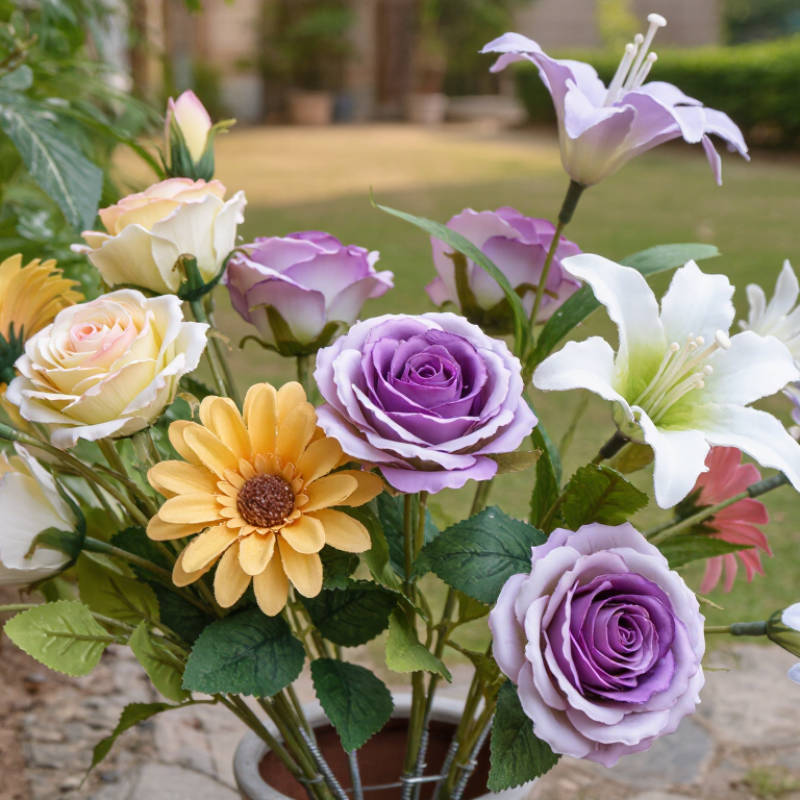
A strong supplier begins with material control, not attractive catalog photos. IMARC Group’s 2024 market assessment valued the global artificial flowers market at about USD 1.9 billion in 2023, with steady growth expected through 2032. This demand increases pressure on suppliers to deliver consistent color, texture, and outdoor durability. The best factories should provide detailed specifications for polyester, plastic, wire, and coating materials. Ask for UV-resistance test results, batch records, and clear sample approval procedures. Small details matter. A leaf should not feel brittle after sunlight exposure.
Manufacturing experience must be visible on the production floor. Reliable suppliers use incoming-material inspection, in-process checks, and final sampling based on recognized quality-control methods. Request an audit report, corrective-action records, and product testing from an independent laboratory. For international shipments, documentation should address applicable chemical, labeling, packaging, and safety requirements in the destination market. The International Trade Centre’s trade data also shows China remains a major global source for decorative manufactured goods, but export volume alone does not prove quality.
Communication is another practical test. Can the supplier explain minimum order quantities, mold changes, replacement policies, and realistic lead times? A factory that admits limitations may be safer than one promising everything. I have seen attractive samples fail during repeated handling because stems loosened or colors varied between cartons. That weakness deserves attention. The best supplier combines verifiable production systems, transparent evidence, responsive service, and enough flexibility for design adjustments.
Artificial garden flowers come in several practical forms. Common choices include rose bushes, hydrangea clusters, lavender stems, hanging vines, and compact boxwood plants. Each type creates a different outdoor mood. Roses add soft color near entrances, while lavender suits narrow paths and balcony planters. Hydrangeas provide fuller coverage in large containers. Product quality depends on more than appearance. I check petal edges, color consistency, stem flexibility, and base stability before recommending a supplier.
Materials affect durability and realism. Polyester fabric offers detailed petals and a softer surface. PVC is easier to clean and often resists moisture. Polyethylene creates thicker, more natural-looking leaves. Many outdoor products include galvanized wire stems and UV-resistant coatings. These features help flowers handle sunlight, wind, and seasonal temperature changes. However, no artificial flower remains perfect forever. Strong sunlight may fade cheaper colors. Dust can also make delicate petals look dull. This point is easy to overlook.
Tips: Match materials with exposure levels. Use UV-treated flowers for open balconies or garden borders. Choose flexible stems for windy locations. Ask for close-up photos before ordering. A small sample can reveal loose petals, plastic shine, or uneven coloring. For real supplier evaluation, check material specifications, care instructions, production consistency, and packaging tests. A beautiful sample is not enough. Steady quality matters more.
Choosing the best artificial garden flowers supplier requires more than attractive catalog photos. I inspect sample stems under daylight and warm indoor light. Color should remain balanced, not strangely bright or gray. Good petals have clean edges, consistent veins, and a natural bend. Touch matters too. Soft fabric often looks more convincing than stiff plastic. Yet softness alone proves little. Materials should recover after gentle handling and resist fraying.
Ask for material specifications, production tolerances, inspection records, and applicable safety documents. Reliable factories can explain their pigment, wire, backing, and coating choices. For outdoor use, request UV exposure data and water-resistance testing. Test a sample yourself. Leave it near a sunny window for several weeks, then compare it with an unexposed piece. Some fading may appear earlier than expected. That result deserves an honest discussion, not a polished excuse.
Check stem strength by moving the arrangement repeatedly. Loose leaves, visible glue, or uneven cuts reveal weak process control.
Design quality depends on proportion. A capable supplier should offer varied flower sizes, leaf angles, and stem lengths. Ask whether color batches are documented. Small differences can become obvious across a large installation. Manufacturing standards also include secure packaging, traceable orders, and final inspection before shipment.
Photographs of packed cartons help, but they are not enough. Request a pre-shipment sample for large orders. My evaluations sometimes overvalue appearance and underestimate maintenance. Dust still collects on realistic petals. A washable surface may matter more than another decorative detail.
China Best Artificial Garden Flowers Supplier?
A strong Chinese artificial garden flower supplier should show more than attractive catalog photos. Ask for production evidence, material specifications, and recent quality records. Experienced teams should explain wire stems, fabric types, UV treatment, and colorfastness clearly. Request samples from the same production line used for bulk orders. That step prevents surprises.
Customization may include petal colors, stem lengths, pot styles, leaf shapes, and packaging designs. Provide reference images, measurements, and approved color samples. Clear drawings matter. For outdoor projects, confirm resistance to sunlight, moisture, and temperature changes. Suppliers should also support sample development and explain revision limits. Not every custom request is practical, especially with low quantities.
Order requirements need careful confirmation. Check minimum order quantities, sample charges, production time, carton dimensions, loading capacity, and payment terms. A reliable quotation lists each item separately. For regulated markets, request applicable material declarations and packaging information. Use pre-shipment inspection when the order is large. Even good suppliers can miss small details, such as uneven flower heads or weak stems. Buyers should record agreed standards in writing. Flexibility is valuable, but vague instructions can create avoidable rework.
The chart shows indicative working-day benchmarks commonly used when planning artificial garden flower orders: sample development, standard production, custom production, packaging artwork, and pre-shipment inspection. Actual timing depends on product complexity, order quantity, material availability, and approval speed.
China Best Artificial Garden Flowers Supplier?
Pricing should be judged by landed cost, not factory quotation alone. In practical sourcing reviews, I compare flower density, UV treatment, carton size, minimum order quantity, and replacement rates. The global artificial flowers market is projected to grow steadily through 2030, according to Grand View Research. This growth increases supplier choices, but not necessarily quality. A low unit price can hide brittle stems and costly rework. Ask for a sample first.
Certifications need careful checking. ISO 9001 supports process control, but it does not prove every flower is durable or weather resistant. Request the certificate number, issuing body, validity period, and exact factory scope. For outdoor products, ask for UV-aging test results and material declarations. Reports should identify test methods. Vague documents are a warning. I have seen attractive certificates fail basic verification.
Shipping performance can change the final margin. UNCTAD’s Review of Maritime Transport reports that maritime shipping carries over 80% of global merchandise trade by volume. Compare FOB, CIF, and delivered pricing with realistic carton dimensions. Confirm production lead time, port options, inspection timing, and damage procedures. Customer support matters after payment. A reliable supplier provides weekly updates, clear photos, and replies within one business day. That standard may be demanding, yet silence during delays becomes expensive. Some buyers overvalue fast replies and undervalue honest problem reporting. Both should be measured.
| Comparison Dimension | Profile 1 Entry-Level Export Supplier |
Profile 2 Mid-Range OEM Supplier |
Profile 3 Premium Project Supplier |
Profile 4 Small-Batch Flexible Supplier |
|---|---|---|---|---|
| Typical Product Range | Standard artificial flower stems, basic greenery, simple garden arrangements | UV-resistant flowers, outdoor planters, custom color combinations, mixed greenery | High-density foliage, realistic botanical designs, commercial landscaping products | Seasonal items, decorative flower baskets, sample-based custom designs |
| Indicative Factory Price | US$0.25–US$1.20 per stem | US$0.80–US$3.50 per stem or arrangement | US$2.50–US$12.00 per stem, panel, or arrangement | US$1.20–US$6.00 per finished item |
| Minimum Order Quantity | Usually 500–2,000 pieces per style or color | Usually 300–1,000 pieces per style; mixed cartons may be negotiable | Usually 100–500 pieces for standard products; project quantities vary | Usually 50–300 pieces per style, subject to material availability |
| Customization Capability | Limited; standard colors, packaging, and size options | Good; color matching, flower-head changes, packaging, and private-label cartons | Advanced; product development, custom molds, landscaping specifications, and sample approval | Good for small changes; limited tooling and large-scale product development |
| Outdoor Durability | Basic outdoor suitability; UV performance must be confirmed by product specification | UV-treated options commonly available; request test data and exposure conditions | Designed for longer outdoor use; verify UV stabilizer type, test method, and warranty terms | Depends on the selected material; outdoor suitability should be confirmed before ordering |
| Material Options | Polyester fabric, plastic stems, wire cores, and PVC components | PE, PVC, polyester, latex-like coatings, galvanized wire, and weighted bases | High-grade PE or fabric foliage, reinforced stems, weather-resistant coatings, and metal frames | Mixed materials based on available stock and the approved sample |
| Quality Certifications | Verify per factory ISO 9001 may be available; product-level documentation is often limited |
Commonly available ISO 9001, BSCI or equivalent social-audit documents may be available upon request |
Documentation-focused ISO 9001, social compliance audits, material declarations, and test reports may be available |
Depends on scale Basic quality records are more common than full third-party certification packages |
| Recommended Compliance Checks | Colorfastness, sharp-edge inspection, packaging strength, and basic material declaration | UV aging data, restricted-substance declaration, carton drop test, and pre-shipment inspection | UV/weathering test method, flame-retardancy requirements where applicable, structural safety, and traceability | Sample approval, material confirmation, color consistency, and final quantity inspection |
| Sample Lead Time | 5–10 working days for existing items | 7–15 working days for existing items or moderate customization | 15–30 working days for engineered or project-specific samples | 5–12 working days when materials are in stock |
| Mass Production Lead Time | 20–35 working days after deposit and artwork approval | 25–45 working days, depending on customization and seasonality | 35–60 working days for large or technically customized projects | 15–30 working days for small standard orders |
| Common Shipping Methods | Sea freight for bulk orders; express courier for samples | Sea freight, rail where available, air freight for urgent replenishment, and courier samples | Sea freight with palletized or containerized loading; project cargo may require special planning | Express, air freight, or consolidated sea freight for smaller shipments |
| Typical Export Transit Time | Approximately 15–40 days by sea after export departure, depending on destination | Approximately 15–40 days by sea; air freight is commonly 3–10 days after departure | Approximately 20–45 days by sea, excluding customs clearance and inland delivery | Approximately 15–40 days by sea or 3–10 days by air after departure |
| Trade Terms Commonly Offered | EXW, FOB, and occasionally CIF | EXW, FOB, CIF, and selected DAP quotations | FOB, CIF, DAP, or project-based logistics quotations | EXW, FOB, and courier or freight-forwarder arrangements |
| Packaging Capability | Standard export cartons with polybags and protective paper | Retail boxes, color labels, barcode labels, inner cartons, and export pallets | Customized protective packaging, pallet engineering, moisture control, and project labeling | Flexible packing for mixed cartons, but fewer automated packaging options |
| Quality Control Process | Basic in-line inspection and final visual inspection | Incoming material checks, in-line inspection, final inspection, and optional third-party inspection | Documented quality plan, approved sample standard, batch traceability, and pre-shipment inspection | Sample comparison and final visual inspection; inspection depth depends on order size |
| Communication and Support | Email or online messaging; response quality may vary by sales representative | Dedicated sales contact, production updates, sample feedback, and packaging coordination | Project manager, technical documentation, scheduled progress reports, and after-sales process | Direct communication and flexible revisions, with limited dedicated project resources |
| Best Fit For | Price-sensitive wholesale orders with standard designs | Retailers, importers, and distributors needing reliable customization and balanced cost | Hotels, commercial landscapes, public spaces, and long-term outdoor installations | Online sellers, seasonal buyers, test orders, and smaller retailers |
| Main Risk to Confirm | Inconsistent color, lower UV performance, and limited documentation | Longer lead times during peak seasons and higher customization charges | Higher unit cost, engineering fees, and longer sample development time | Material substitutions, limited production capacity, and less formal certification support |
| Indicative ranges are general purchasing benchmarks rather than quotations. Final pricing, certification availability, production time, freight cost, customs duties, and outdoor-service claims should be confirmed in writing against an approved sample, technical specification, and purchase contract. | ||||
Common options include rose bushes, hydrangea clusters, lavender stems, hanging vines, and compact boxwood plants. Roses suit entrances. Lavender works well beside narrow paths and balcony planters. Hydrangeas provide fuller coverage in large containers.
Polyester fabric creates detailed petals with a softer surface. PVC is easier to clean and often handles moisture well. Polyethylene gives leaves a thicker, more natural appearance. Galvanized wire stems add support.
Many outdoor products include UV-resistant coatings and moisture-resistant materials. These features help against sunlight, wind, and temperature changes. They are not permanent. Strong sunlight may fade cheaper colors, while dust can dull delicate petals.
Choose UV-treated flowers for open balconies and exposed garden borders. Flexible stems suit windy areas. Use stable bases in containers. A weak base may tip after one strong gust.
Request production evidence, material specifications, recent quality records, and care instructions. Ask for samples from the same production line. Close-up photos help. They may reveal loose petals, plastic shine, uneven coloring, or weak stems.
Customization may include petal colors, stem lengths, pot styles, leaf shapes, and packaging designs. Provide measurements, reference images, and approved color samples. Some requests may be impractical with small quantities.
Confirm minimum order quantities, sample charges, production time, carton dimensions, loading capacity, and payment terms. A clear quotation lists each item separately. Record approved standards in writing.
It is useful for checking uneven flower heads, weak stems, packaging damage, and color consistency. Even good suppliers can miss small details. I may still overlook something, so written checks matter.
Choosing the best Artificial Garden Flowers supplier in China requires more than comparing prices. A reliable supplier should offer a broad selection of garden flowers, including seasonal blooms, greenery, potted arrangements, and decorative outdoor plants, made from durable materials such as UV-resistant plastic, polyester, fabric, and quality synthetic fibers. Buyers should assess color accuracy, realistic textures, structural strength, weather resistance, production consistency, and attention to detail. Clear manufacturing standards and quality-control procedures are also essential for ensuring dependable long-term performance.
A capable supplier should support customization in flower styles, colors, sizes, packaging, and private designs while clearly communicating minimum order quantities, sample policies, production schedules, and payment terms. Comparisons should also include overall pricing, product certifications, packaging quality, shipping arrangements, export experience, and customer support. The best partner is one that combines attractive design, stable quality, flexible order solutions, transparent communication, and reliable delivery to meet the specific needs of wholesalers, retailers, and project buyers.
Shintae